GST and BAS for NDIS Providers: The Hidden Mistakes Costing You Margin
By Loma Naser
After working with hundreds of NDIS providers, I can tell you where the money actually leaks.
It's not pricing. It's not marketing. It's not wages.
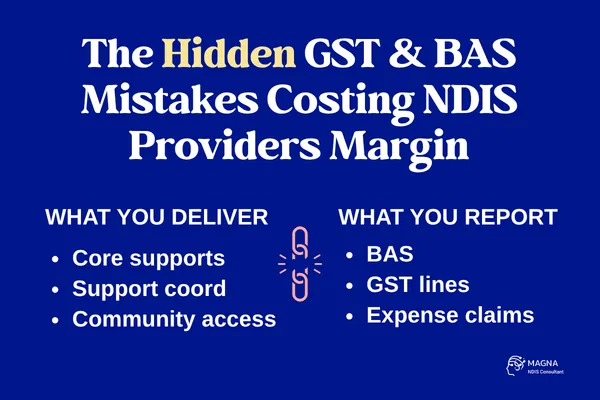
It's the gap between how services are delivered and how they're reported.
Misunderstood GST rules. Incorrect BAS reporting. A financial structure that doesn't match the operation.
And here's the problem — these don't show up when they happen. They show up six, twelve, eighteen months later. In cashflow that doesn't add up. In audit findings no one saw coming. In margins that keep slipping while revenue keeps climbing.
I see this pattern in every kind of provider — startups, scale-ups, $5M+ operators. Good people, ethical operators, strong outcomes for participants. But the financial system behind the business doesn't match how the business actually runs.
Want the full picture? I recently ran a live session on this — GST, BAS, payroll, structure, and the hidden accounting traps NDIS providers fall into. Watch the replay →
Quick Answers
Is NDIS income GST-free? Most NDIS-funded supports are GST-free when they're delivered under a plan, considered reasonable and necessary, and supplied directly to the participant. But not every service a provider delivers is automatically GST-free — and that's where the leakage starts.
Do NDIS providers still need to lodge BAS? Yes. Even if most of your revenue is GST-free, you still lodge — covering total sales, GST on taxable services, GST credits on expenses, and PAYG if you employ staff.
What's the biggest GST mistake? Assuming every service is GST-free without checking how it's funded, delivered, and documented. That single assumption creates reporting errors and audit risk — often for years before anyone notices.
The Misconception That Costs Providers Money
The first thing most providers tell me is: "All our NDIS services are GST-free, so we don't really need to worry about GST."
That's only partly true.
Services are generally GST-free when they're funded under an NDIS plan, considered reasonable and necessary, and delivered directly to the participant. That covers most core supports — personal care, community access, support coordination.
But GST still applies when a service falls outside NDIS funding, you deliver private or top-up services alongside funded ones, there's a mixed component in the same invoice, or admin charges, cancellation fees, or materials get bundled into a support line.
Quick example: a provider I worked with was delivering Support Coordination (GST-free) but charging a separate admin fee for plan printing. The SC was clean. The admin fee wasn't — and it had been invoiced as part of the same GST-free line for over a year. Small error. Six figures of exposure by the time we caught it.
This is where most providers get caught. Not because they're careless — because their systems assume "NDIS = GST-free" and stop thinking.
BAS: More Than a Compliance Task
Your BAS isn't just a box to tick. It's a snapshot of how your business is operating — or isn't.
For NDIS providers, BAS covers total sales (including NDIS income), GST collected where applicable, GST paid on expenses, and PAYG withholding if you employ staff.
Even when most of your revenue is GST-free, BAS still matters — because your expenses still include GST you can claim, your reporting still drives financial visibility, and your lodgement still sits on your compliance record.
Most providers lodge quarterly; larger operators go monthly. The frequency matters less than the accuracy. A BAS lodged on time with bad data is worse than one that's late and right.
The 5 Mistakes Actually Costing You Margin
1. Misclassifying GST-free services. Not every NDIS service is treated the same. Misclassification means overpaying GST, under-reporting liabilities, and sitting on audit exposure you don't know you have.
2. Mixing personal and business finances. If your bank accounts aren't clean, nothing downstream is clean — not your GST claims, not your expense tracking, not your reporting.
3. Weak record keeping. If your documentation can't clearly show what was delivered, how it was funded, and whether GST applies — you're exposed. Not maybe. Exposed.
4. Treating BAS as lodgement only. Outsourcing BAS and never looking at the numbers is the mistake. BAS should feed your cashflow decisions, pricing, and operational planning — not just tick a compliance box.
5. No alignment between operations and finance. This is the big one. If your service delivery model doesn't match how your finances are structured, you get leakage. Quiet, ongoing, compounding.
Where Providers Actually Get Stuck
Most providers don't lack effort. They lack alignment.
Finance sits with the accountant. Operations sit with the service team. Compliance sits in a folder somewhere. None of them talk to each other.
So GST is technically "done." BAS is technically "lodged." Audits are technically "prepared for." And the business still feels unstable — because the three systems that should be running together are running in parallel.
A provider came to me recently doing just over $4M in revenue. Clean audits on paper. BAS lodged on time every quarter. Good external accountant. But margins kept slipping and no one could explain why.
The accountant wasn't wrong. Operations wasn't wrong. Compliance wasn't wrong. They just weren't connected.
Once we aligned the financial structure to the actual service delivery model, the leakage became visible — and fixable.
If Any of This Sounds Familiar
You're not sure your GST classification is actually correct
Your BAS is handled externally and you don't fully understand it
Your margins don't match your revenue growth
You feel exposed every time audit conversations come up
Your finance and operations don't really talk to each other
Then the next step isn't another accounting review. It's looking at your financial system as a whole.
That's exactly what I walk through in the webinar — the hidden accounting traps that scale with your business until they break it. Real examples. 45 minutes. No fluff.
If you only do one thing after reading this, do that.
FAQ
Are all NDIS services GST-free? No. Many are, but private services, mixed services, admin components, and supports outside a participant's funded plan can all have different GST treatment.
Why does BAS matter if most NDIS revenue is GST-free? Because BAS isn't only about GST collected. It reflects how your business records sales, expenses, GST credits, and payroll. If BAS is inaccurate, your financial visibility is weak — and that affects every decision you make from it.
Can BAS mistakes affect audits? Yes. Errors create inconsistencies between financial records, service delivery evidence, and supporting documentation — one of the fastest ways to increase scrutiny.
Should providers rely entirely on their accountant? A good accountant matters, but leadership still needs to understand GST treatment, margins, and reporting logic. If they don't, the risk stays hidden from the people who can actually fix it.
What should providers review first? Service classification, invoicing structure, expense tracking, and whether your BAS reporting actually reflects how services are delivered.
Final Thought
Most providers don't realise they've been reporting incorrectly until something breaks — an audit finding, a cashflow crunch, a margin drop no one can explain. By then, you're reacting. And reactive costs more than proactive every time.
Compliance is the floor. Financial control is the ceiling. Most providers never build the ceiling — and that's why growth feels heavier than it should.
If you want to see what building the ceiling looks like, start with the replay.
When you're ready to work on the system behind your business — not just the numbers on the statement — that's what MAGNA does. But start with the replay first.