How NDIS Providers Can Use LinkedIn to Build Referral Partnerships
Many NDIS providers treat LinkedIn like an online CV.
A few connections.
A job title.
Maybe the occasional post.
But used properly, LinkedIn is something far more powerful.
It is one of the largest targeted referral ecosystems in the disability sector, with an estimated 190,000 professionals connected to the NDIS space in Australia.
These include:
Support coordinators
Hospital discharge planners
Social workers
Allied health providers
Insurance case managers
Community organizations
These professionals influence participant referrals, partnerships, and service collaborations.
Recently, I joined a webinar hosted by Tasha, Head Trainer at Paycat, where I shared how NDIS providers can turn LinkedIn from a passive profile into a powerful referral partnership engine.
Over the years, I have worked with disability providers across Australia to help them use LinkedIn strategically to build professional relationships and referral pathways within the NDIS ecosystem.
This article summarises some of the strategies I shared during the training.
Watch the Webinar Replay
👉 If you want to watch the full webinar, complete the form below and we’ll send the replay directly to your email.
In the webinar, I explain:
How NDIS providers structure LinkedIn profiles for referrals
How to connect with support coordinators and hospitals
The content strategy that builds authority in the disability sector
How professional networking turns into consistent participant referrals
Why LinkedIn Matters for NDIS Providers
For disability providers, LinkedIn functions differently from other social media platforms.
Facebook often connects providers with participants and families.
LinkedIn connects providers with referral partners.
These include professionals working across the NDIS ecosystem:
Hospitals and health networks
Mental health services
Allied health clinics
Community organizations
Insurance providers
Housing and accommodation services
These professionals often influence which providers participants are referred to.
For that reason, LinkedIn is less about selling services directly and more about building trusted professional relationships.
Providers who focus on relationships instead of sales tend to build stronger referral pipelines.
The Biggest Networking Mistake NDIS Providers Make
Many providers treat LinkedIn like a sales tool.
They immediately send messages promoting their services.
This rarely works.
LinkedIn is designed for relationship building before business conversations happen.
A more effective strategy includes:
Interacting with posts from potential partners
Commenting on relevant industry discussions
Sharing insights about disability services
Building familiarity before outreach
This approach builds credibility.
And credibility is what drives NDIS referral partnerships.
How to Optimise Your LinkedIn Profile for NDIS Referrals
Your LinkedIn profile should clearly answer three questions:
Who do you support?
What services do you provide?
Why should referral partners trust you?
Without that clarity, potential partners cannot easily identify whether you are relevant to their clients.
Define the type of participants you serve, such as:
Psychosocial disability participants
Neurodivergent young adults
Participants transitioning from hospital discharge
Participants needing Supported Independent Living (SIL)
The clearer your positioning, the easier it is for referral partners to remember your services.
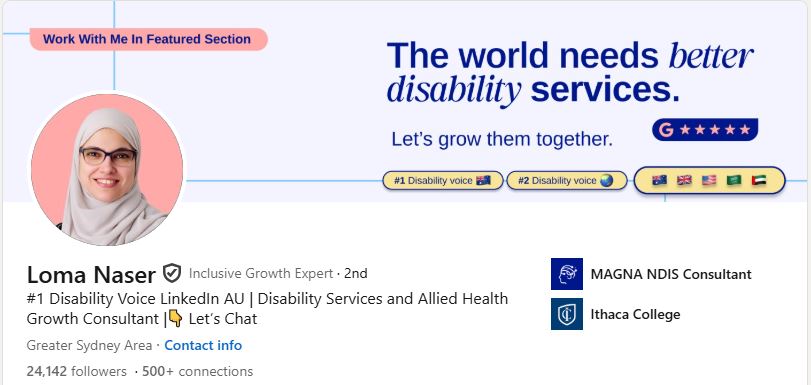
Here’s a snapshot of the structure I recommend when optimising a LinkedIn profile for referrals.
LinkedIn Banner Strategy for NDIS Providers
Your LinkedIn banner is one of the most overlooked elements of a provider’s profile.
A strong banner should communicate four things:
Your unique value proposition
How you deliver services
Social proof or credibility
A call to action
However, simplicity matters.
Too many elements reduce clarity.
Limit your banner to two or three clear messages so the value proposition is immediately understood.
Writing a Headline That Attracts Referral Partners
Many providers use generic titles like:
Founder
Director
Business Development Manager
While accurate, these titles do not explain what services you deliver.
The first 45 characters of your LinkedIn headline are the most visible, particularly on mobile.
Instead of focusing on job titles, focus on services and outcomes.
Example:
Instead of:
Director | Disability Services
Use:
Supporting Psychosocial Disability Participants | NDIS Community Programs | Trauma-Informed Care
This helps referral partners immediately understand whether your services align with their participants.
Using the LinkedIn Experience Section for SEO
The experience section on LinkedIn acts as a search engine keyword bank.
Each service listed becomes searchable on LinkedIn — and sometimes on Google.
Providers should include:
Service categories
Participant cohorts
Disability specialties
Program outcomes
Adding multiple headings within a role can increase visibility for different search terms such as:
SIL provider
Community participation programs
Psychosocial disability support
Disability employment services
This improves discoverability across the NDIS ecosystem.
What NDIS Providers Should Post on LinkedIn
Many providers assume they need complex content strategies.
In reality, simple posts perform best.
Effective topics include:
Changes in NDIS policy
Challenges providers face
Insights from service delivery
Industry trends
Lessons from participant support experiences
Posts discussing real sector challenges often generate strong engagement and reposts.
This visibility strengthens relationships with referral partners.
Building Referral Relationships Across the NDIS Ecosystem
NDIS providers should think beyond just connecting with other providers.
The broader ecosystem includes professionals working in:
Hospitals
Mental health services
Homeless shelters and refuges
Community support organizations
Disability employment services
Many of these professionals regularly refer participants to trusted providers.
Building relationships across this ecosystem significantly expands referral opportunities.
How Strategic Networking Turns Into Referrals
LinkedIn networking works best when it follows a relationship-first approach.
A typical referral journey looks like this:
Connect with relevant professionals
Engage with their content
Share insights and expertise
Build familiarity through interactions
Develop conversations
Transition relationships into referrals
Over time, this creates a professional network that consistently generates opportunities.
Providers who build structured systems around referral partnerships often achieve more predictable growth.
The Role of Trust and Compliance in NDIS Referrals
Referral partners often consider more than just services.
They also assess whether a provider has strong governance and operational systems.
Reliable providers demonstrate:
Clear documentation
Transparent service delivery
Strong compliance frameworks
Participant-centred practices
Many providers strengthen these foundations by implementing continuous compliance systems that keep organisations audit-ready at all times.
This approach reduces audit stress and builds trust with partners across the sector.
Frequently Asked Questions
How do NDIS providers get referrals?
NDIS providers typically receive participant referrals through professional networks within the disability sector.
Some of the most common referral sources include:
Support coordinators who help participants find suitable services
Allied health professionals such as occupational therapists and psychologists
Hospital discharge teams supporting participants transitioning into community care
Local Area Coordinators (LACs) assisting participants to connect with providers
Community organisations supporting people with disability
Because these professionals regularly guide participants through service decisions, building strong relationships with them is essential for sustainable provider growth.
LinkedIn provides a platform where providers can connect with these professionals, share expertise, and develop trusted relationships that often lead to referrals over time.
Is LinkedIn useful for NDIS providers?
Yes. LinkedIn connects providers with the broader NDIS ecosystem, making it one of the most effective platforms for building referral partnerships.
What should NDIS providers post on LinkedIn?
Effective LinkedIn content includes:
Industry insights
NDIS policy updates
Participant success stories
Service innovations
Sector challenges
Where can I watch the full LinkedIn referral strategy webinar?
You can receive the full webinar replay and resources by completing the sign-up form above.
The webinar replay will be sent directly to your email.